
🔊 Listen to Jordan & Quinn’s teacher guide
Explore this chronological Genesis 1 study designed for your Sunday school curriculum or homeschool Bible lesson. This guide offers innovative teaching techniques for the seven days of creation, including prep tips for the Creation Wheel craft and physical memory verse motions. Discover the Jesus Connection to help students see how the Word was present at the very beginning of our world.
📜 View Episode Transcript
Welcome to the Jordan and Quinn show, your premier destination for high-quality Sunday school curriculum and homeschool Bible lessons. Our mission is to provide educators and parents with solid biblical truth and simple preparation tools through the Gospel Resources Hub. In this episode, we dive into a comprehensive chronological study of Genesis chapter 1, exploring the creation story through innovative, Christ-centered lesson plans. Whether you are looking for free Bible stories for kids, engaging Sunday school crafts like the creation wheel, or effective teaching techniques for young children, our resources are designed to be mobile-friendly and easy to implement. Visit thegospelresourceshub.org to download our free eight-week study and discover how we simplify complex theological truths to help you lead the next generation to Jesus.
Jordan: You are listening to the Jordan and Quinn show. Our mission is simple, to provide you with solid truth and simple preparation for your Sunday school or homeschool classroom. Today we examine one of the many free lessons from the Gospel Resources Hub. Let us get started. Today we are diving into God Makes Everything, covering Genesis chapter 1, verse 1 through chapter 2, verse 3, which is part of an eight-week chronological study of Genesis chapters 1 through 11, to walk alongside you as you prepare to teach this to your kids. To download this plan, visit our website at thegospelresourceshub.org. And just a quick note for those typing that in, make sure to make resources plural with an S on the end, so you find the right spot.
Quinn: And, you know, if you have the lesson plan open on your phone or printed out, feel free to follow along as we walk through it together.
Jordan: I really highly recommend having it open because preparation is the one thing that can just completely make or break our confidence as teachers.
Quinn: Oh, absolutely.
Jordan: And that is exactly why this lesson plan is such a powerful tool. It's really designed to make your teaching incredibly easy, but also just deeply impactful.
Quinn: Right, because the Gospel Resources Hub provides these completely free, Christ-centered plans.
Jordan: Yeah. And they take these massive, universized truths and just make them so simple for kids to grasp. And the best part, I think, is that it is so innovative that you can lead the entire class just reading straight from your phone or tablet.
Quinn: Which is huge.
Jordan: You don't need any of those massive binders at all.
Quinn: Let's get right into the heart of this lesson, starting with the Bible story itself.
Jordan: Okay, I have to admit something right out of the gate here. As someone who has spent years in the classroom, my first instinct is usually just to, you know, open the Bible and read the text directly to the kids.
Quinn: Right, that's what we are all kind of trained to do.
Jordan: Exactly. But this lesson plan actually provides a pre-written, perfectly portioned story summary. And I used to wonder, why is that necessary? Shouldn't we just read the raw text?
Quinn: That is such a common question, and it really comes down to how a child's brain processes information. Young children just have a limited capacity for complex sentence structures and ancient phrasing. I mean, when you read straight from a dense text, their cognitive load maxes out.
Jordan: And they just stop listening.
Quinn: Exactly. They completely check out. This lesson plan distills the text so you don't have to figure out how to translate it on the fly. It saves teachers massive amounts of prep time.
Jordan: It's like giving them a steak versus cutting it into bite-sized pieces for them.
Quinn: That's a great way to put it.
Jordan: They are still getting all the nutrition, but now they can actually swallow it.
Quinn: Yeah. And it starts with this beautiful core truth that before anything existed, there was only God.
Jordan: Only God.
Quinn: And he had this magnificent plan, but he needed no tools or wood.
Jordan: Right. No hammers or saws required.
Quinn: None at all. He created everything by simply speaking his powerful words into the darkness.
Jordan: Which is just so cool for kids to visualize. And the way the summary walks through the days is fascinating. It's highly sequential, but it focuses on very specific imagery.
Quinn: Right.
Jordan: Like on day one, God created light and dark. And on day two, he made the sky and the water. But the lesson plan specifically instructs the teacher to explain that God was separating the water on the earth from the clouds in the sky.
Quinn: Which is a very specific detail to highlight.
Jordan: It is. Why focus on that specific detail instead of just saying sky and water?
Quinn: Because children understand the world through physical boundaries.
Jordan: Oh, that makes sense.
Quinn: Right. Look up, there are clouds. Look down, there is water on the ground. It takes the abstract concept of creation and just grounds it in their immediate observable reality.
Jordan: That makes total sense. God is basically building the habitats first, which leads right into day three land and plants.
Quinn: Right. Filling the earth with green grass, colorful flowers and giant trees.
Jordan: And there is a tiny detail included here that I found brilliant. The summary explicitly mentions that he made plants with seeds.
Quinn: Seeds. Yes.
Jordan: Why introduce the concept of seeds to a five-year-old?
Quinn: Well, it introduces the concept of sustainable design.
Jordan: Oh, wow.
Quinn: Yeah, it shows the kids that God didn't just make a static painting. You know, he made a living system that could keep growing.
Jordan: That is so profound for a kid to grasp.
Quinn: It really is. Then on day four, he creates the sun, moon and stars. But again, the lesson plan doesn't just say what they are.
Jordan: Right. It explains why they are there.
Quinn: Exactly. For seasons and time. It brings a sense of order to the child's universe.
Jordan: And we see that order continue on day five with the birds and the fish filling the sky and the water habitats that he built earlier.
Quinn: Yes.
Jordan: But day six is where the scale gets incredible. God makes the animals and the lesson plan specifically contrasts tiny bugs with massive dinosaurs.
Quinn: I love that part.
Jordan: Me too. And then the crowning achievement people created in his own image to care for the earth and God saw it was very good.
Quinn: The contrast of bugs and dinosaurs is a deliberate teaching strategy.
Jordan: Really? How so?
Quinn: It stretches their imagination to the absolute extremes of size. It helps them grasp the sheer scope of God's power.
Jordan: From the smallest to the largest.
Quinn: Exactly. Which makes day seven so important. God rested.
Jordan: Right. And the lesson plan makes a crucial distinction here. He didn't rest because he was tired. He rested to show the work was finished and perfect. That is such a vital theological point hidden inside a very simple children's story.
Quinn: It really is. Now, immediately after wrapping up the story, the lesson plan moves into a section called a curious question.
Jordan: Okay.
Quinn: It prompts the teacher to ask this way. How did all this amazing stuff get here? And does it show us that God has a brilliant plan for everything?
Jordan: That feels like a study shift, honestly.
Quinn: How do you mean?
Jordan: Well, we just finished telling them the answers, right? And now we are asking them a massive open-ended question. Why not just tell them what to think?
Quinn: As a former educator, I can assure you that asking open-ended questions like this is the absolute secret to true engagement.
Jordan: Really?
Quinn: Yes. It prevents the lesson from feeling like a one-way lecture.
Jordan: Oh, I see.
Quinn: When you ask them how this amazing stuff got here, you are inviting them to look at the world around them with theological wonder.
Jordan: Theological wonder. I love that phrase.
Quinn: You are moving them from being passive listeners to active participants in discovering the truth.
Jordan: It turns the classroom into a laboratory of ideas.
Quinn: It completely does.
Jordan: And speaking of massive ideas, this next section of the lesson plan is arguably the most important. It is the Jesus connection.
Quinn: This is where we bridge the gap between the Old Testament creation narrative and the core of the gospel.
Jordan: Exactly. We want to offer a simple, direct explanation of how the creation story points to Jesus. It is so important to explain that Jesus wasn't just watching from the sidelines.
Quinn: Right. He was active.
Jordan: He was there at the very beginning with God the Father. The lesson plan takes us to John chapter 1, where Jesus is called the Word.
Quinn: And noting that nothing was made without him.
Jordan: Yes. And the analogy provided here is just stunning in its simplicity.
Quinn: It really is.
Jordan: It says that just as God the Father spoke the world into existence, bringing light into the darkness, Jesus came to be the light of the world to lead us out of the darkness of sin. Pause for two seconds.
Quinn: When you really let the weight of that truth sink in, it completely shifts the dynamic of the room.
Jordan: It does. It changes everything.
Quinn: We aren't just teaching ancient history, you know. We are teaching a rescue mission that started at the dawn of time.
Jordan: A rescue mission.
Quinn: Wow. From there, the lesson plan guides us into the discussion questions.
Jordan: And rather than just reading a dry list of review questions, we want to focus on what connects with the mind of a child.
Quinn: Exactly.
Jordan: There is one specific question in the lesson plan that actually stops me in my tracks.
Quinn: Which one?
Jordan: It asks, when God looked at everything he made, he called it very good. What do you think that tells us about God's heart and the way he feels about us?
Quinn: Oh, wow.
Jordan: I mean, think about the mind of a seven-year-old answering that.
Quinn: Right. Because seven-year-olds are in a developmental stage where they are desperately craving affirmation.
Jordan: Yes, exactly.
Quinn: They're just starting to figure out where they fit in the world. And they often feel very, very small.
Jordan: It's like they are building a house of self-worth. And right now, they are just laying the foundation.
Quinn: Right.
Jordan: When they realize that God's very good creation directly applies to how he feels about them, it pours solid concrete into that foundation.
Quinn: It really does.
Jordan: It creates a powerful, personal aha moment where they realize their incredible value.
Quinn: But I love that the lesson plan doesn't let them just sit with that warm feeling.
Jordan: What do you mean?
Quinn: It moves them into action with the, so what, what can I do section.
Jordan: Oh, right.
Quinn: It outlines three distinct, actionable steps for the kids so they can live with joy and purpose because God is the creator.
Jordan: And this is where the rubber meets the road.
Quinn: Exactly.
Jordan: The first step is to start with praise. The application is to stop and thank God when seeing a sunset or hearing birds.
Quinn: Which is so simple, but so good.
Jordan: And the lesson plan notes that it is much harder to be grumpy when you are busy thanking God.
Quinn: That is true for adults too.
Jordan: It really is.
Quinn: Right.
Jordan: Now the second action step is to be a good steward. This includes not littering, being kind to animals, and cleaning up their own things at home to respect what God made.
Quinn: Yes.
Jordan: Now, I have to push back a little here. Clean your room as a form of biblical stewardship. Is that just a clever trick for parents or is there real theological weight there?
Quinn: It is absolutely theological.
Jordan: Okay, sound me on it.
Quinn: Well, we have to translate grand truths into a six-year-old's reality, right? Their bedroom or their playroom is their earth. That is their domain.
Jordan: Oh, wow. I never thought of it that way.
Quinn: By teaching them to respect their immediate environment, you are training them in the foundational habit of stewardship. You are showing them that respecting creation starts with the toys on their floor.
Jordan: I love that. It's turning a mundane chore into a cosmic responsibility.
Quinn: Exactly.
Jordan: And the third step is remember your value. Reminding themselves when they feel lonely or sad that the king of the universe made them in his image.
Quinn: That is a lifeline for a kid having a tough day at school.
Jordan: It anchors their emotions to a permanent truth.
Quinn: It does. Now, to help cement all of this, the lesson plan introduces the memory verse.
Jordan: Which is Genesis chapter 1 verse 1, right?
Quinn: Yes. In the beginning, God created the heavens and the earth.
Jordan: But it doesn't just ask them to repeat it like robots. It includes physical hand motions.
Quinn: And they are so fun. For in the beginning, you point backward over your shoulder.
Jordan: Okay, I'm doing it. Pointing backward.
Quinn: For God created, you point up and sweep your arms wide.
Jordan: Nice.
Quinn: For the heavens, you reach high. And for the earth, you point down toward the floor.
Jordan: Now, why all the gymnastics? Does waving our arms around actually help them memorize the verse?
Quinn: It absolutely does because of how muscle memory wires the brain.
Jordan: Really?
Quinn: Yeah. When you pair a physical action with spoken words, you're creating a dual pathway for recall.
Jordan: Oh, fascinating.
Quinn: If a child forgets the next word in the sentence, the physical habit of reaching their hands high into the air will trigger the brain to remember the heavens. Wow. It is a highly effective teaching mechanism disguised as play time.
Jordan: So the physical movement is almost like a save button for their brain. That is brilliant.
Quinn: It really is.
Jordan: From there, the lesson plan shifts the energy into a quieter moment with the praying with kids section.
Quinn: Which is so needed after all that movement.
Jordan: It provides a beautifully simple sample prayer. It thanks the powerful creator for the stars, animals, and plants.
Quinn: Just a great recap of the lesson.
Jordan: But the part that gets me is where it marvels that the same God who made the giant sun made each child personally.
Quinn: That contrast is so deliberate.
Jordan: It is.
Quinn: Placing the incomprehensible size of the sun right next to the individual child is a wonderful way to express God's infinite power and his intimate love simultaneously.
Jordan: It is so comforting. The prayer concludes by asking God for help to remember they are made in his image and to be good helpers. It is just a perfect summarization of the lesson.
Quinn: Which brings us to the craft section. Because what is Sunday school without a craft?
Jordan: True. We are making the creation wheel, right?
Quinn: Yes. You take two white paper plates, a brass fastener, and some crayons or stickers. Kids cut a pie slice window out of the top plate, divide the bottom plate into seven sections for the seven days, and connect them so the top spins freely.
Jordan: Okay, I'm going to be the skeptic again here.
Quinn: Go for it.
Jordan: I look at paper plates and brass fasteners and my mind immediately jumps to, busy work to kill the last 10 minutes of class. Is the creation wheel actually effective?
Quinn: I completely understand that fear. It is easy to view crafts as just a distraction to keep their hands busy until parents arrive.
Jordan: Right.
Quinn: But this specific craft serves as a take-home review mechanism.
Jordan: A review mechanism.
Quinn: Yeah. When they finish, they don't just have a nice picture to hang on the fridge, they have a storytelling tool.
Jordan: Oh, because it spins to each day.
Quinn: Exactly. The kids spin it and they get to practice telling the story of what God made on each day to their friends and their parents. It empowers the child to become the teacher.
Jordan: It totally flips the dynamic. They walk out of the room eager to present what they built. That is so much better than just handing them a coloring page.
Quinn: Way better.
Jordan: And speaking of making things better, the final section of the lesson plan offers some incredibly practical, effective teaching techniques to keep kids engaged during a long story.
Quinn: Because delivery is everything.
Jordan: It really is.
Quinn: The lesson plan suggests using dramatic voices, large hand gestures, and a strong, steady voice when speaking God's words to convey his power.
Jordan: It also gives some fantastic wiggle room for younger kids, specifically those ages four to six.
Quinn: Oh, that is so helpful.
Jordan: Instead of stressing out and trying to force them to memorize all seven days perfectly, it suggests focusing heavily on just a few days, like the animals and the stars.
Quinn: Which removes so much pressure from the teacher.
Jordan: Absolutely.
Quinn: Another technique highlighted is the use of sensory elements. It encourages teachers to bring in large leaves, smooth rocks, or seashells for kids to actually touch during day three and day five.
Jordan: Oh, I love that idea.
Quinn: Young children don't just learn through their ears. They learn through their fingertips. A smooth rock makes the abstract concept of dry land instantly tangible.
Jordan: Touch creates such a strong memory. The lesson plan also includes some brilliant time savers. Like what? Well, if class time is running short, it suggests pre-assembling the creation wheels before the kids even arrive. That way you avoid the chaos of 20 kids struggling with scissors.
Quinn: Oh, that is a lifesaver.
Jordan: And if the wiggles start taking over, there is a suggestion to sing a simple chorus of God made everything between the days to let them reset their focus.
Quinn: When you look at all these elements combined, the story summary, the deep questions, the physical movements, and the teaching tips, it is clear how incredibly versatile this lesson plan is.
Jordan: It is. And before we wrap up, think about this. If God took his time to build this universe systematically over six days, building the habitats before filling them, when he could have just snapped his fingers and done it in a millisecond, what does that tell us about the value of patience and structure in our own teaching? Wow. We don't have to rush the truth. We just have to present it clearly. Whether you are in a traditional Sunday school classroom, a homeschool setting, or just doing family discipleship around the living room coffee table, this framework gives you everything you need.
Quinn: To download this plan, visit our website at thegospelresourceshub.org.
Jordan: That's resources with an S. Plural. Don't forget that part.
Quinn: Exactly. Resources plural.
Jordan: Solid truth. Simple prep. Always free.
Quinn: The Gospel Resources Hub provides these free lesson plans to help you lead kids to Jesus.
God Makes Everything
(Genesis 1:1 - 2:3)
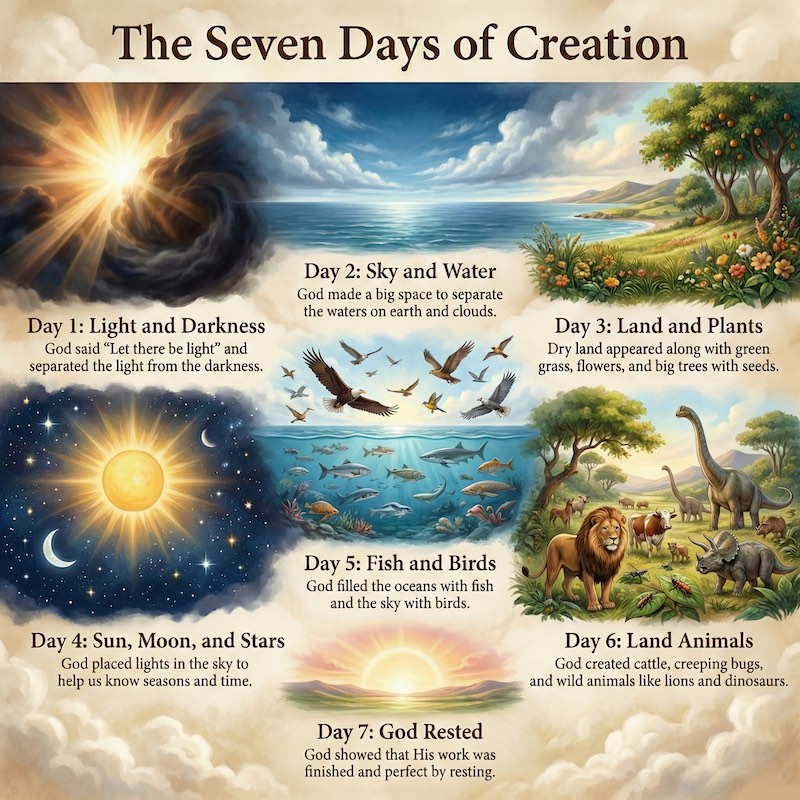
Before anything existed, there was only God. There was no light, no sound, and no color. He had a magnificent plan to create a whole world, but He did not need tools or wood to build it. God created everything by simply speaking His powerful words into the darkness.
Day 1: Light and Dark. God said, "Let there be light!" and light appeared out of nowhere. He called the light "Day" and the darkness "Night." It was the very first sunrise the world had ever seen.
Day 2: Sky and Water. God made a vast sky to separate the water on the earth from the water in the clouds above. He called the sky "Heaven." Now there was water below and water above, with open air in between.
Day 3: Land and Plants. God moved the water so dry land would appear. He filled the earth with green grass, colorful flowers, and giant trees. Every plant had its own seeds so that more life could grow later, again and again, without God needing to start over.
Day 4: Sun, Moon, and Stars. God placed great lights in the sky. He set the sun to rule the day and the moon to rule the night, and He scattered stars across the darkness too. These lights mark the seasons, the days, and the years, so we always know when a new day begins.
Day 5: Birds and Fish. God filled the deep oceans with splashing fish of every size and the wide sky with soaring birds of every color. Some fish were tiny enough to hide inside a shell, and some were massive creatures of the deep. God blessed them and told them to fill the earth with life.
Day 6: Animals and People. God made every kind of land animal, from tiny bugs to massive dinosaurs. Then God did His most special work of the whole week: He created people in His own image. No other creature was made like this. He told them to care for the earth and rule over it. When God looked at everything He had made, He saw it was very good.
Day 7: Rest. God rested. He was not tired, and He did not need a break. He wanted to show us that His work was finished and perfect. He made the seventh day a special day of rest, a pattern for us to follow every week.
A Curious Question
Have you ever looked at the sun, the stars, the animals, and even yourself and wondered: "How did all this amazing stuff get here, and does it show us that God has a brilliant plan for everything?"
Jesus Connection
Jesus was not just watching from the sidelines. He was there at the very beginning. The Bible tells us that Jesus, God's Son, was with God the Father when everything was made. In John 1, Jesus is called "The Word," and the Bible says that nothing was made without Him. Think of it like this: God the Father spoke the world into existence through Jesus. Just as God brought light into a dark world during creation, Jesus came to be the Light of the World to lead us out of the darkness of sin.
Discussion Questions
- If you could have been there to see God create one specific thing, what would you have picked to see first?
- When God looked at everything He made, He called it very good. What do you think that tells us about God's heart and the way He feels about us?
- God made tiny bugs and massive dinosaurs on the very same day. What does that tell you about how big and how creative God is?
"So What?" What Can I Do?
Because we know God is the Creator of everything, we can live with joy and purpose! Here are three ways to practice trusting Him this week:
- Start with Praise: When you see a beautiful sunset, a colorful flower, or hear birds singing, stop for a second and say: "Thank You, God, for Your amazing creation!" It is much harder to be grumpy when you are busy noticing the good things God has made.
- Be a Good Steward: God gave humans the job of taking care of the earth. You can do this by not littering, being kind to animals, and taking care of your own things at home. This shows God that you respect what He has made.
- Remember Your Value: On the most important day of creation, God made you. Whenever you feel lonely or sad, remind yourself that the King of the Universe made you in His own image and loves you more than you can imagine.
Memorize God's Word
Genesis 1:1: "In the beginning God created the heavens and the earth."
Hand Motions:
- In the beginning: Point backward over your shoulders with both hands to show the past.
- God created: Point up to heaven with both index fingers, then sweep your arms out wide.
- the heavens: Reach both hands as high as you can toward the sky.
- the earth: Point both hands down toward the ground beneath your feet.
Praying with Kids
Dear Father, thank You for being the powerful Creator who made our beautiful world. Thank You for every star in the sky, every animal in the forest, and every plant in the field. We are amazed that the same God who made the giant sun also made us and loves us personally. Help us to remember that we are special because we are made in Your image. Teach us to be good helpers who take care of Your creation this week. In the name of Jesus: Amen.
Craft or Activity
Creation Wheel
This spinning wheel is a wonderful way for children to visualize how God filled the world over seven days.
Materials Checklist:
- Prepare the Cover: Take the first paper plate and cut a "pie-slice" shaped window from the edge to the center. This will be the window that reveals each day.
- Map the Days: On the second paper plate, divide the circle into seven equal sections. Have the children glue a sticker or draw a picture for each day of creation in its own section.
- Decorate: Encourage the students to color the top plate and write "God Made Everything" on the front.
- Connect the Plates: Poke a small hole through the center of both plates. Push a brass fastener through the holes and spread the tabs on the back so the top plate can spin freely.
- Review: Have the children spin their wheels and practice telling what God made on each day to a friend.
Effective Teaching Techniques
To keep your students engaged during this long story, try using dramatic voices and large hand gestures for each day of creation. When you speak God's words, use a strong and steady voice to show His power. For younger children (ages 4 to 6), you might find it more effective to focus heavily on just a few days: such as the animals and the stars: rather than trying to memorize all seven at once.
Adding a sensory element can make the lesson much more memorable. Consider bringing in nature items like large leaves, smooth rocks, or sea shells for the children to touch while you describe Day 3 and Day 5. If your class time is running short, you can pre-assemble the creation wheels before the students arrive. This allows them to spend their time coloring and discussing the story instead of struggling with scissors or brads.
Finally, music is a powerful tool for elementary learners. Try singing a simple chorus of "God Made Everything" between the different days of the story. This gives the children a chance to wiggle and reset their focus before you move on to the next part of the account.
Frequently Asked Questions
- Why didn't God just make everything all at once instead of taking seven days?
- The Bible doesn't tell us exactly why God chose to create in seven days instead of a single moment. What we do know is that God rested on the seventh day, giving us a pattern to follow for our own rest each week.
- What did God make people out of?
- Genesis 1 tells us God made people in His own image, but it doesn't give the details of how. Those details come later, in Genesis 2.
- Was there really nothing at all before God started creating?
- Yes. Before God spoke, there was no light, no land, no water, and no living thing. Only God existed, and everything else came from His powerful words.