
Free Gospel-Centered Sunday School Curriculum
for Elementary Kids
for Elementary Kids
Download biblically sound, Christ-centered lesson plans built for immediate use.
Download biblically sound, Christ-centered lesson plans built for immediate use.
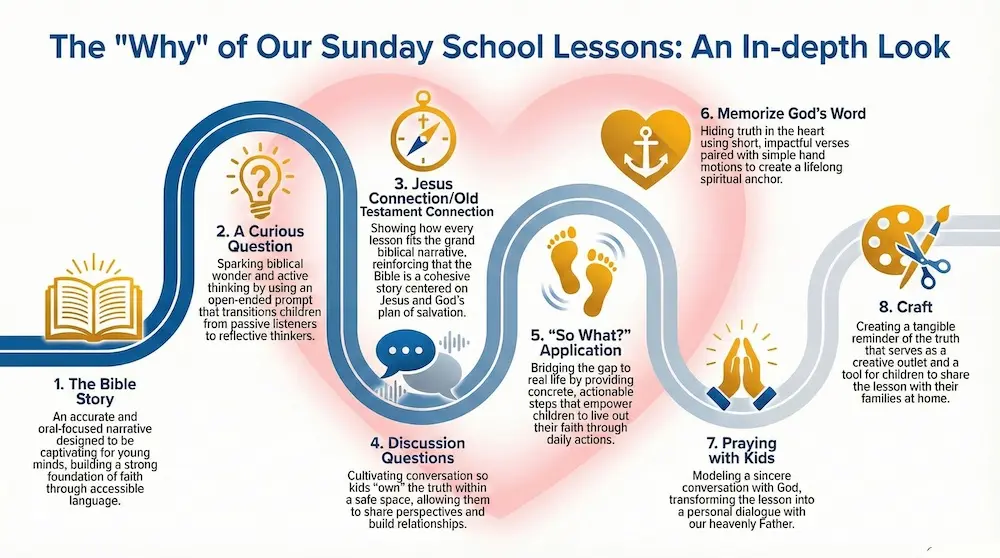
Welcome! Whether you have taught Sunday school for twenty years or this is your very first Sunday behind the teacher's table, thank you for saying yes to this work.
Every lesson on this site follows the same basic shape, and this page walks through why. None of it is arbitrary. Each piece is there because it does something specific, moving kids past just hearing a Bible story toward actually knowing the God the story is about. Once you see how the pieces fit together, you will be able to teach with a lot more confidence, even on the mornings when you feel underprepared.
Every lesson starts with the Bible story itself, retold in plain, natural language that still holds tightly to what the text actually says. Think of it less like a summary and more like a script, something built to be read aloud with your own voice rather than handed to a child to read silently.
That matters because kids are drawn to a story told to them, not at them. Since the language has already been shaped for biblical accuracy, you are free to focus on the room in front of you: eye contact, pacing, a little drama when the moment calls for it. You are not performing a script you have to fact-check on the fly. You already know it is trustworthy, so you can just tell it well.
Right after the story wraps up, you'll find one open-ended question. It's not a recall check ("what did the man do next?") but something closer to a genuine puzzle, a question meant to make a child sit with a piece of who God is or what He did.
This is the hinge between hearing and thinking. Kids move through stories quickly, and without something to pause on, a Bible account can slide right past them the same way a cartoon does. One good question slows that down. It gives the class a reason to wonder out loud before you have even started the formal discussion, and wondering is usually where real understanding begins.
This part draws a straight line between the week's lesson and the larger story the Bible is telling. We treat Scripture as one continuous account rather than a shelf of unrelated tales, so in Old Testament lessons this section is called the Jesus Connection, pointing ahead to the Messiah still to come. In New Testament lessons it flips, becoming the Old Testament Connection, showing how what just happened fulfills a promise God made long before.
Kids start to grasp real biblical literacy the moment they notice Jesus standing at the center of the whole book, not just the New Testament half of it. Seeing the Old Testament promises land in the New Testament story gives children solid evidence that God keeps His word. It also protects them from the common trap of hearing the Bible only as ancient history rather than something still very much alive and relevant today.
This is a small set of open-ended questions built to turn the lesson from something you deliver into something the class actually talks through together. There's no hidden right answer you're steering them toward. The goal is simply to give kids room to say what they noticed, what confused them, and how the story lands in their own lives.
Once the curious question has gotten kids leaning in, these discussion prompts keep that going. They give quieter kids a chance to speak and let the room feel less like a lecture and more like a conversation. Remind yourself as you lead it: this is not a quiz. It's a chance for a child to say the truth out loud in their own words, which is often the moment it stops being just a story they heard and starts being something they believe.
Here we hand kids one specific, doable next step tied to the lesson, something small enough to actually happen this week rather than a vague call to "be good." It might be a kind word to a sibling, a prayer for a friend, or a small act no one else will notice.
The goal was never just to fill a child's head with Bible facts. It's to see that truth move into how they actually live. This step is what turns "that was a nice story" into "here's what I'm going to do about it," and giving kids something concrete to do, rather than just something to remember, is what starts building the habit of a faith that shows up outside of Sunday morning.
Each lesson closes with a short verse that sums up its main point, paired with a simple hand motion for every phrase. The motion isn't decoration. It gives kids with different learning styles another way into the words, and movement tends to help things stick.
Scripture memory is one of the most useful habits you can hand a child, and this section makes it easy to build without extra prep on your part. Years from now, when that child faces something hard, it's often a verse learned at age seven that comes back to mind first. What you're doing here is quietly stocking a shelf they'll draw from for the rest of their life.
This is a short sample prayer that shows kids what it sounds like to talk to God plainly about whatever the lesson just covered. It's not formal or scripted-sounding. It's meant to feel like something a kid could actually say themselves.
Our aim isn't just to teach children about God, it's to teach them to actually talk to Him, and that can feel intimidating when you're eight and He's, well, God. Hearing a simple, honest prayer models what that conversation can sound like. You may be the only place all week where prayer looks normal to a child, so leading it well matters more than it seems.
Every lesson includes a hands-on project connected to that week's theme, something to build or make with their hands rather than just hear about.
Kids learn in different ways, and for a lot of elementary-age children, their hands understand things before their heads fully catch up. A craft gives those kinds of learners something to hold onto, literally. It also tends to travel home and start a conversation there. A kid who walks in the door with something they made is far more likely to tell a parent about it than a kid who just remembers a story, which stretches your one hour on Sunday into a conversation that keeps going all week.
This last section is a short list of practical suggestions: classroom tricks, storytelling ideas, small ways to keep a room of kids engaged.
You don't need to be a natural performer to teach well. These tips exist so you can lean into whatever you're already good at, whether that's a dramatic voice, a simple prop, or just a knack for asking good follow-up questions. Use what fits you and skip what doesn't. The point isn't to turn you into someone else. It's to help every kid in the room walk away having actually heard what you came to tell them.
A good curriculum is more than nine well-designed pieces. It's how those pieces work together over time. Here's the short version of what all of this adds up to:
We take it seriously that children deserve the real thing, not a softened or simplified version of the truth. Every story here is written in plain language, but the meaning, the context, and the weight of what actually happened in the text stay intact. Simple words are not the same as a simplified message, and we try hard not to confuse the two.
That's what lets you teach without hedging. We do the work of getting the history and context right so you don't have to, which frees you to focus on the kids in front of you instead of worrying whether what you're saying is true. We believe that when the Word is taught faithfully, God does what He has always done with it. Our job is just to be faithful with the material. The rest is His.