
🔊 Listen to Jordan & Quinn’s teacher guide
Enhance your classroom with this free Genesis 2 Bible study exploring the creation of the first family and the Garden of Eden. This kids' ministry resource features effective teaching techniques for elementary students, including a step-by-step paper chain craft and physical memory verse actions to improve retention. Help your students discover the Christ-centered connection between the first man and the salvation offered through the second Adam.
📜 View Episode Transcript
Welcome to the Jordan and Quinn show, your premier destination for high-quality Sunday school curriculum and homeschool Bible lessons. Our mission is to provide educators and parents with solid biblical truth and simple preparation tools through the Gospel Resources Hub. In this episode, we dive into a comprehensive chronological study of Genesis chapter 2, exploring the creation story through innovative, Christ-centered lesson plans. Whether you are looking for free Bible stories for kids, engaging Sunday school crafts like the creation wheel, or effective teaching techniques for young children, our resources are designed to be mobile-friendly and easy to implement. Visit thegospelresourceshub.org to download our free eight-week study and discover how we simplify complex theological truths to help you lead the next generation to Jesus.
Jordan: You are listening to the Jordan and Quinn show. Our mission is simple, to provide you with solid truth and simple preparation for your Sunday school or home school classroom. Today, we examine one of the many free lessons from the Gospel Resources Hub. Let us get started. Today, we are diving into God's perfect plan for people and marriage, covering Genesis chapter 2, verse 4 through 25, which is part of an eight-week chronological study of Genesis chapters 1 through 11 to walk alongside you as you prepare to teach this to your kids. To download this plan, visit our website at thegospelresourceshub.org. And just a quick note for those typing that in, make sure to make resources plural with an S on the end, so you find the right spot.Quinn: It is so good to be looking at this together today. Because, you know, if you are listening right now, you know exactly how hard it can be to find materials that are, well, that are actually free, deeply Christ-centered, and genuinely easy to use. And the Gospel Resources Hub provides exactly that. These free plans are such an innovative, powerful tool because they take these massive foundational truths and make them incredibly simple for kids to grasp. And as a former educator, I love that you can lead the lesson right from a phone or tablet.
Jordan: Yeah, that is a huge game changer for anyone teaching. So, if you have the lesson plan open on your phone or, you know, if you printed it out, feel free to follow along as we walk through it together because you really can lead this entire thing right from your device.
Quinn: Right, whether you're on a classroom rug or just at your kitchen table.
Jordan: Exactly. Well, we have a lot of ground to cover to help you get ready, so let's get right into the heart of this lesson, starting with the Bible story itself.
Quinn: I am so glad we are starting here because the lesson plan does something really helpful right at the top. It has the entire narrative perfectly summarized for you.
Jordan: Which is such a relief.
Quinn: It really is. As a teacher, you don't have to spend your Friday night reading through endless commentaries trying to figure out how to synthesize ancient history for a room full of squirmy young kids. It is completely ready to go. It saves you so much valuable prep time.
Jordan: I got to admit, though, when I first saw we were covering the creation of Adam and Eve, my immediate thought was, okay, we have all taught this a hundred times.
Quinn: Oh, for sure. It's the classic Sunday school story.
Jordan: So my worry was always, how do we keep this from feeling like we are just reciting a dry timeline of events, just checking boxes for the kids?
Quinn: That is the exact trap we fall into. Because the story is so familiar to us as adults, we forget the wonder of it. But if you look at how the lesson plan frames the summary, it doesn't just list facts.
Jordan: Yeah, it really leans into the sensory details.
Quinn: Exactly. It sets the scene by describing this beautiful brand new world. Instead of just saying, you know, God made plants, it paints this picture of a soft mist rising up from the ground to water the earth.
Jordan: I loved that detail. It notes that there were no farmers yet, nobody to plant seeds or care for the land. And then, and this is my favorite part, God does something that completely shifts the scale of the story. Up until now, God has been speaking galaxies into existence from afar, but here he knelt down to the ground.
Quinn: Yeah, that changes everything for a kid listening. The God of the universe kneeling in the dirt.
Jordan: Right. He knelt down and he used the dust to carefully shape and mold a man. And then God leaned in close and breathed his own breath of life into the man's nostrils. The lesson plan points out that suddenly the man became a living soul and God named him Adam.
Quinn: And from there, the story moves into the home God prepared for him. The lesson plan describes the magnificent Garden of Eden. It was filled with trees that were not just delicious to eat from, but visually stunning to look at.
Jordan: And running right through the middle of this paradise was a sparkling river that branched out into four massive rivers. It's just a beautiful image. And God puts Adam in charge of caring for this incredible space.
Quinn: But he also gives Adam a rule. One single rule, do not eat from the tree of the knowledge of good and evil. Now, as someone who works with kids, I know that the moment you say the word rule, a child's brain automatically translates that to Oh, 100%.
Jordan: Rules mean the fun stops.
Quinn: Exactly. Which is why it is so crucial how the lesson plan explains the why behind the rule. It specifically notes that God gave this rule to protect Adam and to teach him to trust God's plan.
Jordan: That is such a huge shift.
Quinn: It is. It shifts the concept of rules from a restriction to a safety net built on trust.
Jordan: So Adam is in this perfect place and God brings all the wild animals and birds to him so he can give them names. But as Adam is doing this, he starts to notice a pattern. Every single creature has a male and a female partner. Right. But Adam looks around and realizes he's totally alone. There is no one else like him.
Quinn: And God declares that this is not good. So the lesson plan describes how God caused Adam to fall into a deep sleep, took one of his ribs and created Eve.
Jordan: I mean, just imagine waking up to that. Adam was absolutely thrilled. He recognized her instantly as his own bones and his own body. God brought them together as the very first marriage.
Quinn: And I love how the lesson plan emphasizes that they were perfect partners, perfect helpers and best friends living without any fear or shame.
Jordan: It is a beautiful place to pause the story because Adam's realization of being alone naturally leads right into lesson plans. Next section, the curious question.
Quinn: Yes, the curious question is such a vital tool for teaching. It is this open ended prompt designed to get kids wondering about a core biblical truth before you just hand them the answer.
Jordan: So what is the prompt for this lesson?
Quinn: The prompt asks, when Adam saw all the animals had partners, but he was alone, God said it was not good. What does that tell us about how much God cares when we feel lonely?
Jordan: Oh, wow. I love what this does. It takes this giant cosmic event, literally the dawn of human history, and it immediately shrinks it down to a child's everyday emotional reality. You go from learning a historical fact about the first people on Earth to showing kids the deep personal care God has for our emotions right now.
Quinn: Because honestly, a child might not relate to naming an elephant, but every single child knows exactly what it feels like to be lonely on a playground or, you know, sitting alone in the cafeteria.
Jordan: Yeah, that hits close to home.
Quinn: By framing the question this way, you are teaching them that God isn't some distant boss who only cares about our behavior. He is a father who notices our isolation and actively moves to comfort us.
Jordan: It makes God so approachable for them. But we have to be careful because every deep dive we do into these plans shows that they don't just stop at moral lessons or emotional comfort.
Quinn: Right. They never just stop there.
Jordan: They ultimately point to our need for a Redeemer, which brings us to the Jesus Connection section.
Quinn: Yes, this is where the narrative pivots. Every single story points to Jesus.
Jordan: And I actually need to push back on this section just a little bit.
Quinn: OK, let's hear it.
Jordan: Because the lesson plan brings up Romans chapter 5, verse 14, where the Bible calls Jesus the second Adam. And honestly, teaching high level theology like that to a seven year old sounds incredibly daunting to me. Are we not at risk of completely losing their attention with complex terms?
Quinn: It's a completely valid concern. I mean, if you stand up and start defining systematic theology, you will lose them in 10 seconds flat. Right. But look at how the lesson plan actually handles it. It doesn't use heavy jargon at all. It relies entirely on contrast, which is a concept kids understand perfectly.
Jordan: OK, unpack that for me. How does it do that?
Quinn: Well, the lesson plan simply explains that while the first Adam disobeyed God in a garden, Jesus, the second Adam, obeyed his father perfectly. It shows that Adam and Eve's sin broke our friendship with God, leaving us spiritually alone.
Jordan: Wow.
Quinn: But Jesus brings us salvation. He fixes that broken friendship and puts us in God's forever family so we never have to be alone again.
Jordan: Yeah.
Quinn: It takes a massive theological concept and grounds it in the idea of a forever family.
Jordan: Let's just let that sink in for a second. It is so powerful. But, you know, breaking the silence after a heavy, beautiful moment like that is always tricky as a teacher.
Quinn: It really is.
Jordan: You want to see what they absorbed, but you can't just interrogate them. This is where the lesson plans discussion questions come in.
Quinn: And you really have to look at the sequence of these questions because they are very intentionally designed.
Jordan: Oh, for sure. The very first question it suggests is, if you were Adam, what is the funniest name you would have given to an elephant or a monkey? I love that one. I really appreciate it because it feels like hiding vegetables in a kid's mac and cheese. You lead with the flavor they love, which is pure silliness, to deliver the actual nutrients they need.
Quinn: That is the perfect analogy. As an educator, I can tell you that if you jump straight into asking a roomful of young kids, how does God care for your feelings? P.O., you're going to get blank stares. Or kids just staring at their shoes.
Jordan: Yeah, their emotional defenses are way up.
Quinn: Exactly. But asking them about funny monkey names, that hooks their imagination immediately. When kids laugh, their defenses drop. They feel safe in the room.
Jordan: That makes so much sense.
Quinn: And once they are warmed up and engaged, they are far more willing to answer the deeper questions that follow in the lesson plan. Questions like how God was paying close attention to Adam's feelings, and what this story teaches us about how families should treat each other.
Jordan: It is such a smart progression, but getting them talking is only half the battle, right? We have to get them moving and applying it, which is why I love the so what, what can I do section.
Quinn: Yes. Knowing the story isn't enough. We need practical, actionable steps for the kids to apply it today.
Jordan: And the lesson plan gives them three incredibly clear actions. The first one is to pick one person in your family today and tell them, I am so glad God put you in my family. Think about the impact of that. Why is it so important for a child to actually say those words out loud, rather than just, you know, feeling them?
Quinn: Because articulating gratitude literally builds neural pathways in a developing brain. When a child vocalizes appreciation, it shifts their focus from what they want to the value of the people around them. It builds a habit of empathy.
Jordan: I love that. The second actionable step is to ask a parent or a teacher. Is there one thing I can do to help you right now? And the crucial instruction here is that they have to do it with a happy heart.
Quinn: Right. Because begrudging obedience isn't really helping. It teaches them that their attitude matters just as much as their actions.
Jordan: And the third step is so simple. The next time they see an animal, they should say a quick prayer, thanking God for being a creative creator. It turns an ordinary moment into an act of worship.
Quinn: To really cement all these truths long term, the lesson plan then moves into the memorize God's word section.
Jordan: Yeah. The memory verse here is Genesis chapter one, verse 27. And the lesson plan provides specific hand motions. Now we all know kids have a lot of energy, but how much does tying physical movement to a Bible verse actually help them remember it?
Quinn: Oh, it is everything. When you just ask a child to repeat words, you are only using auditory memory. But when you add physical movements, you are creating muscle memory. Let's walk through the exact motions the lesson plan provides.
Jordan: OK, let's do it.
Quinn: For the phrase, so God created man. The kids cup their hands together as if they are shaping clay.
Jordan: Which ties perfectly back to the visual of God kneeling in the dust.
Quinn: Exactly. Then for the phrase in his own image, they place both hands over their heart and stand up tall, emphasizing that we carry his design inside us.
Jordan: I like that.
Quinn: Next for male and female, they hold their right hand out, then their left hand out with their palms facing up.
Jordan: And finally, for he created them, they interlock their fingers together to show how God brings people together as partners.
Quinn: It is brilliant because the physical movements actually act as a trigger for the words in their brain.
Jordan: From all that active movement, the lesson plan seamlessly transitions into a quieter space with the praying with kids section. And I will tell you, as someone who has volunteered in Sunday school classrooms for years, I'm so grateful for this.
Quinn: Oh, I bet it takes the pressure off.
Jordan: It really does. Sometimes the pressure is on. Kids are wiggling around and your mind just goes completely blank. You just forget how to form a sentence. Having a ready-to-use sample prayer provided in the lesson plan is a lifesaver, so you don't have to invent one on the spot.
Quinn: It removes the panic for the teacher. Absolutely. But it also models a really well-structured prayer for the kids. The lesson plan's prayer says, Dear Father, thank you for kneeling down in the dust to create us and for breathing your own life into us. Thank you for the gift of family and for giving us friends so that we never have to be alone. Please help us to be kind helpers to our parents and friends this week. We love you and we thank you for your perfect plan. Amen.
Jordan: It is just beautiful. It takes the entire lesson, the dust, the gift of family to cure our loneliness and the call to be kind helpers, and wraps it into a few simple sentences.
Quinn: And after that quiet moment of prayer, we bring the energy back up with hands-on learning in the craft section. For this lesson, the kids make a helping hands family chain.
Jordan: Oh, this is a classic activity. But the materials are so simple. You just need construction paper, child-safe scissors, crayons, and transparent tape.
Quinn: Yes, and that tape is going to be very important later.
Jordan: It definitely will be. So you take the paper and accordion fold it. Then you draw the outline of a simple person on the top fold. But the key here is making sure the hands reach all the way to the side edges.
Quinn: Yeah, if the hands don't touch the edges, the whole chain falls apart when you cut it.
Jordan: Exactly. So they cut out the person, making sure not to cut the folded edges where the hands meet. And when they unfold it, they have this wonderful chain of friends holding hands, which they can decorate to look like their family or friends from church.
Quinn: But the real value here isn't just the paper craft itself. It is how the lesson plan helps you utilize the activity. This brings us to the effective teaching technique section, which gives you practical tips to really bring the lesson to life.
Jordan: And the first tip is called the creation connection.
Quinn: Right. As the kids are cutting and unfolding their chains, the teacher explains that just as these paper figures are physically connected at their sides, God created Eve from Adam's own side.
Jordan: That is so smart.
Quinn: It is a tangible way to show that husbands and wives are designed by God to be a close team.
Jordan: What a fantastic way to connect a simple craft directly to the theology of the text. The lesson plan also includes a prep shortcut. Time is always an issue. And for five and six year olds, an accordion fold can be really frustrating. So it suggests pre-folding the paper and drawing the outline for them ahead of time.
Quinn: That allows them to just focus on practicing their careful cutting, which will save you so much time. But I have to say, my absolute favorite teaching technique in this entire lesson plan is the classroom management tip.
Jordan: Oh, because let's be real. No matter how much you prep, a child is inevitably going to accidentally cut through the hands and their paper chain will break into pieces. Usually that results in a complete meltdown and tears.
Quinn: Exactly. But the lesson plan flips that entire scenario. It suggests that if a child breaks their chain, you pull out that transparent tape we mentioned earlier, and you use it to heal the connection. And as you're taping it back together, you teach them that even when we make mistakes and our real families and our relationships break, forgiveness is like the tape.
Jordan: Wow.
Quinn: It helps fix things and keeps us loving each other.
Jordan: I mean, that is incredible. It transforms a frustrating craft mistake into a profound gospel moment about forgiveness and grace. That is why these resources are so uniquely helpful, which really leads us to our audience application. Because of the clear structure, the simple preparation, and these built-in teaching techniques, these lesson plans are so versatile. They are absolutely perfect for a traditional Sunday school classroom, but they work just as beautifully in a homeschool setting. Or honestly, as a simple family discipleship guide for parents who just want to do devotions at the kitchen table, the heavy lifting of figuring out the pacing and the deep theological questions, it's already done for you. It frees you up to just focus on the kids and the conversation. Before we wrap up our deep dive today, I want to leave you with a final thought to mull over. We live in an age where our kids are more digitally connected than any generation in history, yet all the research tells us they are the most profoundly lonely generation we have ever seen. When you teach this lesson, you aren't just teaching ancient history. You are reminding them of the garden design that God specifically wired us for physical, intentional, side-by-side community. In a world of screens, teaching a child that God cares about their loneliness and designed a forever family for them might be the most countercultural, hope-filled message they hear all week. To download this plan, visit our website at thegospelresourceshub.org.
Quinn: That's resources with an S, plural. Don't forget that.
Jordan: Exactly, resources, plural.
Quinn: Solid truth. Simple prep. Always free.
Jordan: The Gospel Resources Hub provides these free lesson plans to help you lead kids.
God's Perfect Plan for People and Marriage
(Genesis 2:4-25)
After God finished making the beautiful world and saw that it was very good, He began the next part of His plan.
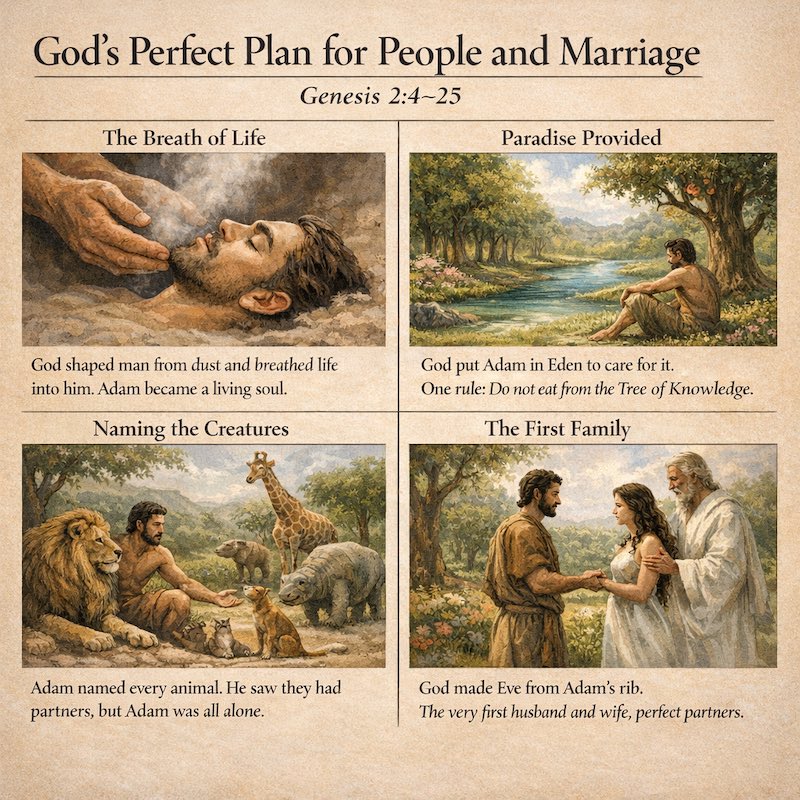
The world was brand new. Soft mist rose up from the ground to water the earth, but there were no farmers yet to plant seeds or care for the land. So, God did something truly wonderful. He knelt down to the ground and used the dust to carefully shape and mold a man. Then, God leaned in close and breathed His own breath of life into the man's nostrils. Suddenly, the man became a living soul. God named him Adam.
God planted a magnificent home for Adam called the Garden of Eden. It was filled with every kind of tree that was beautiful to look at and delicious to eat. Right in the middle of the garden stood two special trees: the Tree of Life and the Tree of the Knowledge of Good and Evil. A sparkling river flowed out of Eden to water the garden, and from there it branched out into four massive rivers called the Pishon, the Gihon, the Tigris, and the Euphrates. Near one of those rivers was a land with gold, and the Bible says the gold there was pure and good. God put Adam in this paradise to work it and take care of it. He told Adam, "You are free to eat from any tree here, except one: the Tree of the Knowledge of Good and Evil. The day you eat from it, you will certainly die." God gave this rule to protect Adam and teach him to trust God's plan.
Then, God brought all the wild animals and birds to Adam to see what he would call them. Whatever Adam called each living creature, that became its name. Adam gave every creature a name, from the biggest animal to the smallest bird, but as he watched them, he saw that they all had partners, a mommy and a daddy, a male and a female. But for Adam, there was no one else like him. Not one of the animals was a suitable helper for him. God saw this and said, "It is not good for the man to be alone. I will make a helper who is just right for him."
God caused Adam to fall into a very deep sleep. While he slept, God took one of Adam's ribs and used it to carefully create a woman. When Adam woke up and saw her, he was so happy. He said, "She is part of my own bones and my own body!" He named her Eve. God brought them together as the very first husband and wife. They were perfect partners, helpers, and best friends, living together in God's beautiful world without any fear or shame.
A Curious Question:
When Adam saw all the animals had partners but he was alone, God said it was 'not good.' What does that tell us about how much God cares when we feel lonely?
Jesus Connection
This story of the first family points us to Jesus Christ. Adam was the first man, but the Bible calls Jesus the "Second Adam" (Romans 5:14). While the first Adam disobeyed God in a garden, Jesus always obeyed His Father perfectly. When Adam and Eve sinned, our friendship with God was broken, but the gospel tells us that Jesus came to fix it. Through His salvation, He brings us back into God's forever family so we never have to be alone again.
Discussion Questions
- If you were Adam, what is the funniest name you would have given to an elephant or a monkey?
- How can you tell from this story that God was paying close attention to Adam's feelings?
- Since Eve was made from Adam's side to be his partner, what does that teach us about how families should treat each other?
"So What?" What Can I Do?
- Pick one person in your family today and tell them, "I am so glad God put you in my family."
- Ask your parents or your teacher today, "Is there one thing I can do to help you right now?" and then do it with a happy heart.
- The next time you see an animal, whether it is a pet or a bird outside, say a quick prayer thanking God for being such a creative and powerful Creator.
Memorize God's Word
Genesis 1:27: "So God created man in His own image, male and female He created them."
Hand Motions:
- So God created man cup your hands together as if you are shaping clay or dust.
- in His own image place both hands over your heart and stand up tall.
- male and female hold your right hand out, then your left hand out, palms up.
- He created them interlock your fingers together to show how God brings people together.
Praying with Kids
Dear Father, thank you for kneeling down in the dust to create us and for breathing your own life into us. Thank you for the gift of family and for giving us friends so that we never have to be alone. Please help us to be kind helpers to our parents and friends this week. We love you and we thank you for your perfect plan. Amen.
Craft or Activity
The "Helping Hands" Family Chain
We will create a paper chain of people to remember how God created Adam and Eve to be partners and helpers, forming the very first family.
Materials Checklist:
Instructions:- Fold your construction paper back and forth like an accordion (about 3 inches wide per fold).
- Draw the outline of a simple person on the top fold. Make sure the hands reach all the way to the side edges!
- Carefully cut out the person, but do not cut along the folded edges where the hands meet.
- Unfold your paper to see your chain of friends holding hands.
- Decorate each person to look like someone in your family or a friend from church.
- Tape several chains together to make one giant circle of "Helpers" for the classroom!
Effective Teaching Techniques
- The Creation Connection: As the children cut their chains, explain that just as these figures are connected at the sides, God created Eve from Adam's own side. This shows us that God designed husbands and wives to stay close and be a team in the very first family.
- Prep Shortcut: For 5 and 6 year olds, the "accordion fold" can be tricky. Pre-fold the paper and draw the person's outline for them ahead of time so they can focus on practicing their careful cutting skills.
- Classroom Management: If a child accidentally cuts through the hands and the chain breaks, use it to teach about forgiveness. Use a small piece of tape to "heal" the connection, explaining that even when we make mistakes in our families, God wants us to help fix things and keep loving one another.
Frequently Asked Questions
- Why did God bring the animals to Adam?
- God wanted Adam to name every animal. As Adam named them, he noticed that each animal had a partner, but he did not have one like himself.
- Why couldn't Adam eat from the Tree of the Knowledge of Good and Evil?
- God gave Adam that one rule to protect him and to teach him to trust God's plan, even when he did not understand it fully.
- How did God make Eve?
- God caused Adam to fall into a deep sleep, took one of his ribs, and used it to create Eve, the first woman.