
God Calls Abram (Genesis 12)
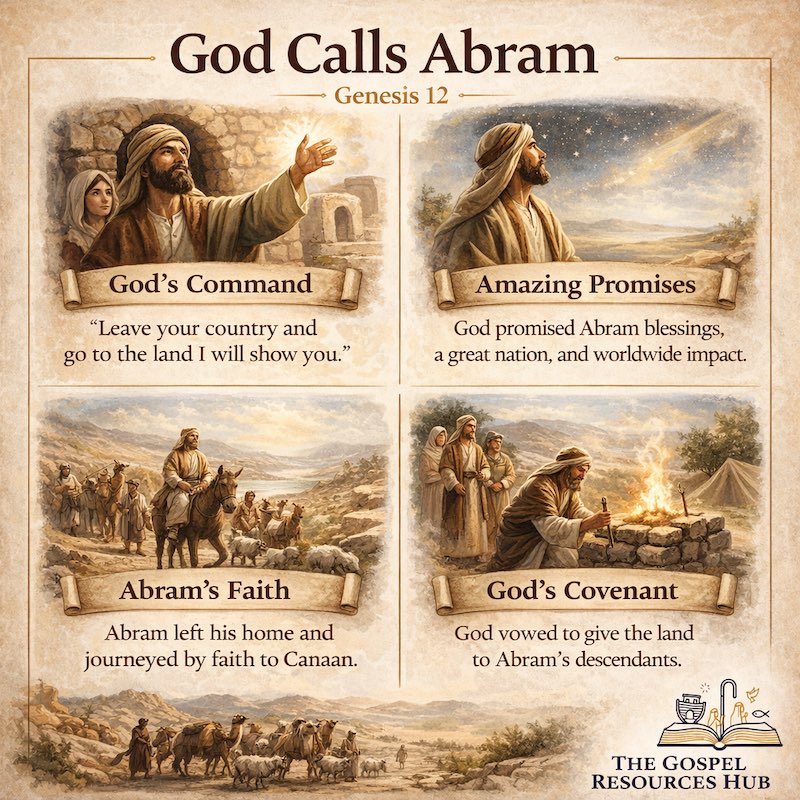
Long ago, a man named Abram lived with his wife, Sarai, in a place called Haran. His father Terah had already brought the family partway on a journey from Ur of the Chaldeans, and they had settled in Haran. One day, God spoke to Abram with a massive request: "Leave your country, your relatives, and your father's house. Go to a land that I will show you." God was asking Abram to leave everything familiar, his home, his extended family, and the only life he had ever known, and head into a land he could not yet name.
Along with this command, God gave Abram amazing promises. He promised to make Abram into a great nation, to bless him, and to make his name famous. He promised to bless those who blessed Abram and to curse anyone who treated him with contempt. Most importantly, God said that through Abram's family, all the families of the earth would be blessed. This was not a small promise. It meant that what God was about to do in one man's life would reach every nation on earth.
Even though he didn't know the exact path, Abram trusted God. He was already seventy-five years old, an age when most people would expect to stay settled rather than start over. But he packed up his belongings, gathered his servants, his flocks, and his herds, and set out for the land of Canaan with Sarai and his nephew, Lot.
When Abram reached the land, he traveled as far as a place called Shechem, to the great tree of Moreh. The Canaanites were living in the land at that time, so Abram was a stranger there with no land of his own. There God appeared to him and said, "To your offspring I will give this land." Even though Abram had no children yet and owned nothing there, he believed God and built an altar to worship Him right at that spot. From there he moved on to the hills east of Bethel, pitched his tent between Bethel and Ai, and built another altar, calling on the name of the Lord.
Abram kept moving through the land God had promised, traveling steadily toward the Negev, trusting the Lord one step at a time. He did not own the land yet, and he still had no children, but he believed with all his heart that God would do exactly what He had said. Every altar he built along the way was a marker of that trust, a reminder that even in an unfamiliar land, Abram belonged to the God who had called him there.
A Curious Question
If God asked you to go on a journey today but didn’t tell you where you were going, what do you think would be the hardest part about trusting Him?
Jesus Connection
God’s promise that all families on earth would be blessed through Abram was the first big clue about His plan of salvation. This promise was fulfilled centuries later through Jesus Christ, a descendant of Abram. Galatians 3 tells us that this very promise to Abram was actually the gospel preached ahead of time, because God always planned to bless every nation through Christ. Because of Jesus, people from every nation can be forgiven and join God’s family. This shows us that God is a faithful promise-keeper who has been planning to reach our hearts since the very beginning.
Discussion Questions
- If you were in Abram's shoes, what would you have been most curious or worried about as you started walking toward a land you had never seen?
- Abram built an altar at Shechem and another one at Bethel before he owned any of the land or had a single child yet. Why do you think he stopped to worship God in the middle of a journey that was still so uncertain?
- When you feel uncertain or afraid about a big change, how does knowing that God is a faithful promise-keeper help you feel better?
"So What?" What Can I Do?
- Take One Step: This week, when you feel scared or worried about something new, stop and remember that God is with you, just like He was with Abram. You don't have to see the whole path. Just take the next step in front of you.
- Build Your Own Altar: Find a quiet spot this week, like Abram did at Shechem, and take one minute to thank God for something specific He has already done for you.
- Practice Trusting: Pick one thing you don't have control over this week, like a test, a tryout, or a new situation, and tell God out loud that you trust Him with it.
- Remember the Promise: Because Jesus made you part of God's family, you can trust Him even when you don't know what will happen next. Practice obeying God with your whole heart this week, knowing He always keeps His promises to His children.
Memorize God's Word
"The Lord had said to Abram, "Go from your country, your people and your father's household to the land I will show you." ~ Genesis 12:1
Use these hand motions to help kids remember God's call:
The Lord had said to Abram: Point up to the sky with both hands, then point toward a friend.
Go from your country: Use your thumb to point over your shoulder at the space behind you.
your people: Stretch your arms out wide to make a big circle.
and your father's household: Touch your fingertips together above your head to make a roof shape.
to the land: Hold your hands out flat in front of you as if showing a wide field.
I will show you: Point to your eyes with your index fingers, then point straight ahead.
Praying with Kids
Dear Father, thank You for always being with us, just like You were with Abram. We are so glad that You are a faithful promise-keeper. Please help us to trust You with our whole hearts, even when we don't know what is coming next. Thank You for sending Jesus to be the greatest blessing for every family on earth. Amen.
Craft or Activity
Abram's Journey Map
Children will create a tangible reminder of the truth by mapping out Abram’s journey from Ur to the land God promised. This activity helps kinesthetic learners process the distance Abram traveled by faith.
Materials Checklist:
- Title the Map: Provide a piece of construction paper and have the kids title it "Abram's Journey."
- Mark the Endpoints: Mark a starting point on one side labeled Ur and a destination point on the other labeled Canaan.
- Draw the Path: Draw a wavy path connecting the two cities to represent the long walk Abram took in obedience to God.
- Mark the Promise: Add a bright star at Canaan to symbolize the land of God's promise.
- Add the Travelers: Use stickers or drawings to show Abram, Sarai, and their animals traveling along the road.
- Finish the Map: Decorate the map with small altars or extra stars to remind everyone that God is faithful and always with us on the journey.
Teacher Tips for Impact
Use a Visual Map: Show the kids a real map of the Middle East to point out the actual distance between Ur and Canaan. Seeing the long path helps them understand the immense faith it took for Abram to obey God’s call.
Interactive Storytelling: Keep young minds focused by letting them help you tell the story. Have the children mimic your actions, like pretending to pack a heavy bag or shielding their eyes to look at the "dust of the earth," as you describe Abram’s journey.
Emotional Connection: Lead a quick role-play where kids pretend to say goodbye to their favorite toy or a best friend. Ask them how it feels to leave things behind, then remind them that God’s presence made Abram brave enough to go.
Frequently Asked Questions
- Why did God tell Abram to leave his home?
- The Bible doesn't tell us every reason, but we know God wanted to make Abram into a great nation and bless the whole earth through his family. God asked Abram to trust Him and go to a new land that He would show him.
- Did Abram know where he was going?
- No, God simply told Abram to go to a land He would show him. Abram did not know the exact path or destination. He trusted God and set out for Canaan by faith.
- How old was Abram when he left his home?
- The Bible tells us Abram was seventy-five years old when he left Haran and set out for the land of Canaan.