
The Birth and Prophecy of John the Baptist
(Luke 1:57-80)
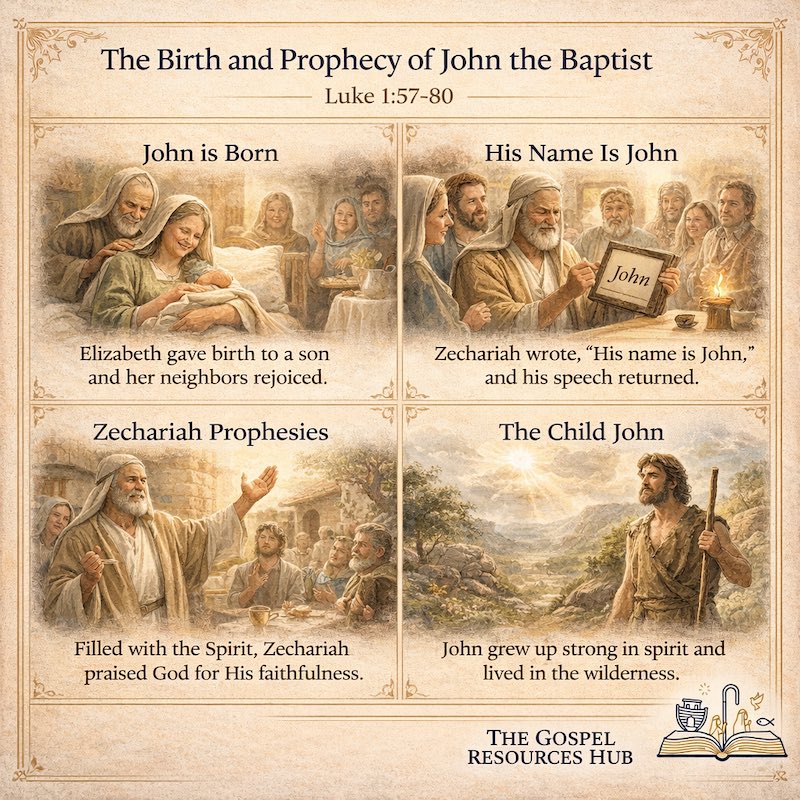
When the time came, Elizabeth gave birth to a son. Her neighbors and relatives heard how the Lord had shown her great mercy, and they celebrated with her. When the baby was eight days old, everyone gathered for the naming ceremony. They assumed the child would be named Zechariah after his father. But Elizabeth said clearly, "No! He is to be called John."
The neighbors were confused because no one in the family had that name. They turned to Zechariah, who had been unable to speak since the angel's visit, and made signs to ask what he wanted. He asked for a writing tablet and wrote five simple words: "His name is John." The moment he wrote it, his mouth opened, his tongue was set free, and he began to praise God. A sense of wonder came over the whole hill country of Judea. The people kept saying to each other, "What is this child going to be?"
Filled with the Holy Spirit, Zechariah spoke a beautiful prophecy now called the Benedictus. He praised God for keeping His covenant with Abraham and David. He told his tiny son that he would be called a prophet of the Most High and would go before the Lord to prepare His way. John's job was to give God's people the knowledge of salvation through the forgiveness of their sins, and to guide their feet into the way of peace. The child grew up and became strong in spirit, and he lived in the wilderness until the day he appeared publicly to Israel.
A Curious Question
Zechariah could not say a single word for nine months. Then the moment he obeyed God and wrote the name John, his voice came rushing back. Why do you think obedience was the key that unlocked Zechariah's voice? Can you think of a time when doing the right thing felt like it opened a door for you?
Old Testament Connection
Zechariah's song is filled with the language of the Old Testament. He quotes from the covenant God made with Abraham in Genesis 17 and the promise God made to King David in 2 Samuel 7. For hundreds of years, Israel had been waiting for God to keep those promises. Prophets spoke about it. Psalmists sang about it. And then it went quiet. For 400 years after the prophet Malachi, there was silence.
Zechariah's praise is the sound of that silence breaking. He is not announcing something new. He is declaring that God remembered. Every promise He made to Abraham, to David, to the prophets, was still alive. The rescue was beginning. John's birth was God's announcement that the waiting was over, and that the One who would fulfill every covenant was already on His way. This is the pattern of the whole Bible: God makes a promise, time passes, people doubt, and then God keeps it exactly as He said He would. Not because anyone earned it. Not because Israel was faithful enough. Because God is faithful, full stop.
Discussion Questions
- Elizabeth and Zechariah both insisted the baby's name must be John even though the whole family disagreed. What does their boldness tell us about what it looks like to obey God even when the people around us do not understand?
- The neighbors asked, "What is this child going to be?" God had already answered that question before John was even born. Why is it encouraging to know that God has a purpose for people before they even arrive?
- Zechariah said John would guide people into the way of peace. How is peace different from simply not having arguments? What does real peace with God look like?
"So What?" What Can I Do?
Zechariah spent nine months in silence. When his voice returned, the first thing he did was praise God. He did not complain about the waiting. He did not explain himself to the neighbors. He just worshipped. This week, start one day with praise before you ask God for anything. Try saying three things you are thankful for out loud before your feet hit the floor in the morning. See what it does to the rest of your day.
Memorize God's Word
Luke 1:76: "You will go before the Lord to prepare the way for Him."
Hand Motions:
- You will go before the Lord: Point straight ahead with one finger as if showing the direction of a path.
- to prepare the way: Use both hands to sweep a clear path in front of you, like pushing something aside.
- for Him: Point both hands up toward heaven.
Praying with Kids
Dear Father, thank You for keeping every single promise You have ever made. Thank You for the nine months Zechariah was silent, because they remind us that Your timing is always right even when we do not understand it. Thank You that the moment Zechariah obeyed, You gave him back his voice. Help us to obey You quickly and then praise You loudly. Fill us with Your Spirit so that our lives point others toward Jesus, the way of peace. Amen.
Craft: Prophecy Scroll
Children will create a scroll to experience what it felt like for Zechariah to write the name John and then speak a prophecy about his son's purpose in God's great story.
Materials Checklist
Instructions
- Cut a piece of white paper in half lengthwise to make a long, narrow strip.
- Have each child write the name John large in the center, just as Zechariah did on his writing tablet.
- Below the name, have them write or copy the memory verse: Luke 1:76.
- Tear the edges of the brown construction paper gently to make it look aged, then glue the white strip in the center.
- Tape or glue a wooden craft stick to each short end of the paper.
- Roll the scroll from both ends toward the middle. When they open it, they are unrolling God's prophecy.
Effective Teaching Techniques
The dramatic centerpiece of this story is Zechariah at the naming ceremony. Before you read that scene, call for total silence in the room and hold it for about fifteen seconds. Then say quietly, "This is what Zechariah felt for nine months." When you finally read that he wrote the name John and his voice returned, let your own voice rise with joy. That contrast between quiet and praise is the emotional heartbeat of the lesson. For younger children, focus on the miracle of the baby and the simple truth that God always keeps His promises. Bring a small whiteboard and let a child come up and write the name John in big letters. That one physical action will stick with them longer than a worksheet ever could. When you reach Zechariah's song, you can summarize it simply: "God remembered Abraham. God remembered David. And now God was sending His Son."