
Abram and Lot Choose Their Paths
(Genesis 13)
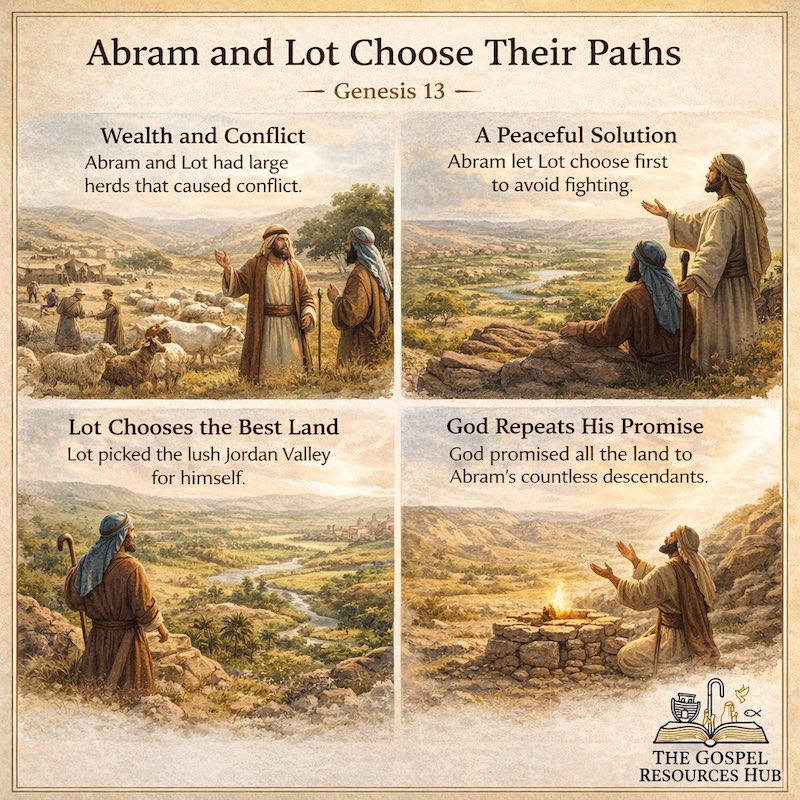
After leaving Egypt, Abram and his nephew Lot traveled back through the Negev toward Bethel, to the same place between Bethel and Ai where Abram had built an altar before. By now Abram was very rich in livestock, silver, and gold, and Lot also had his own flocks, herds, and tents. The land could not support them living so close together, because their possessions were too great for them to stay in one place. Soon, quarreling broke out between the herdsmen who tended Abram's animals and the herdsmen who tended Lot's animals, and the Canaanites and Perizzites were also living in the land at that time.
Abram knew that fighting hurts families. He said to Lot, "Let there be no quarreling between you and me, or between your herdsmen and mine, for we are close relatives. Is not the whole land before you? Let's part ways. If you go to the left, I will go to the right, or if you go to the right, I will go to the left." As the older relative, Abram could have chosen the best land for himself, but instead he chose to be a peacemaker and let Lot choose first.
Lot looked out and saw the whole Jordan Valley, and it was well watered everywhere, like the garden of the Lord. So Lot chose the whole plain of the Jordan for himself and set out toward the east, and the two men parted from each other. Lot settled among the cities of the plain and pitched his tents near Sodom, even though the people of Sodom were wicked and were sinning greatly against the Lord. Abram, meanwhile, settled in the land of Canaan and did not complain about the dry, rocky hills that were left to him. He trusted God to provide.
After Lot had left, the Lord said to Abram, "Lift up your eyes and look from where you are, to the north, south, east, and west. All the land that you see I will give to you and your offspring forever. I will make your offspring like the dust of the earth, so that if anyone could count the dust, then your offspring could be counted. Arise, walk through the length and breadth of the land, for I will give it to you."
So Abram moved his tents and went to live near the great trees of Mamre at Hebron, and there he built an altar to the Lord, knowing that God's promises are better than any piece of land.
A Curious Question
Have you ever had to choose between two things, and you really wanted the better one for yourself? What does it mean to give up something you want just to help a friend or family member? Why is it sometimes better to not get your way if it means keeping the peace?
Jesus Connection
Abram’s selfless choice is a biblical shadow of what Jesus Christ did for us. While Abram gave up the best land to keep peace with his family, Jesus gave up His royal throne in Heaven to come to earth as a servant. In Matthew 5, Jesus teaches that the peacemakers are blessed and will be called children of God, and Jesus Himself is the ultimate Peacemaker who gave up His life on the cross to bring us back to God. Just as Abram trusted God to provide in the rocky hills, we can trust that Jesus is our true inheritance who makes us part of God’s family forever.
Discussion Questions
- What was the problem between Abram and Lot, and how did Abram’s choice to be a peacemaker solve it?
- How did Abram’s willingness to let Lot go first prove that he trusted God to take care of him?
- Can you think of a time when it was difficult to be generous? How does Jesus’ example help us choose peace?
"So What?" What Can I Do?
- Let Someone Go First: The next time you and a friend or a sibling want the same toy or the same seat, remember Abram's example and let them choose first. Being a peacemaker means putting others before yourself because you know that God is the one who truly provides everything you need.
- Step Between Arguments: If you see friends arguing at school or during a game, don't join the fight. Instead, help them be kind to each other.
- Choose Peace Over Winning: When you want to win an argument, choose to act like Jesus by staying calm and doing what is right with a happy heart instead.
- Trust God With What You Give Up: When you give up something you wanted, tell God about it and thank Him for always providing for you, just like He provided for Abram.
Memorize God's Word
"Blessed are the peacemakers, for they shall be called sons of God." ~ Matthew 5:9
Hand Motions:
- Blessed are the peacemakers: Hold your hands out and bring them together as if shaking hands with a friend
- for they shall be called: Cup your hands around your mouth like you are calling out a name
- sons of God: Point both hands straight up toward the sky
Praying with Kids
Dear Father, thank You for sending Jesus, who is the greatest Peacemaker of all. We thank You that He gave up His place in Heaven to bring us back to You. Please help us to be like Abram and choose to be kind and patient with our family and friends today.
When we feel like arguing or getting our own way, help us to remember that You will always provide for us. Teach us to trust Your promises more than the things we see. We ask this in the name of Jesus, Amen.
Craft or Activity
My Peace Promise Bracelet
In this activity, kids will create a tangible reminder to be peacemakers, just like Abram and Jesus. As they work, emphasize that a peacemaker doesn't just stop a fight but actively chooses to be generous and kind.
Materials Checklist:
How to Make the Peace Promise Bracelet:- Add the Promise Bead: Begin by explaining that each bead on the bracelet represents a different part of the biblical story and a personal promise to be a peacemaker. Start with a special charm or unique bead to represent God’s promise to Abram. This reminds the children that we can be generous because God has already promised to take care of us.
- Add the Green Bead: Have the children add a green bead to represent the lush, beautiful land that Lot chose for himself.
- Add the Brown Bead: Add a brown or tan bead for the dry, rocky land that Abram accepted.
- Add a Personal Bead: Let each child choose a bead in their favorite color to represent themselves and their commitment to choosing peace in their own lives.
- Finish and Talk: Have them string the beads, tie the ends together, and talk about one specific way they can be a peacemaker at home or school this week.
Effective Teaching Techniques
Before the children arrive, create a sample Peace Promise Bracelet so you have a visual guide to show them. Having the beads and cords pre-separated into small bowls will help the activity run smoothly and keep the focus on the biblical truth rather than the supplies.
For younger children, use pipe cleaners instead of cord because they are much easier for small hands to manage. If you have older students, you can challenge them to write a specific peacemaker pledge on a small card to keep with their bracelet. As they work, encourage the kids to help one another with difficult knots. This is a great way to put the lesson into practice immediately by showing patience and kindness in the classroom.
Frequently Asked Questions
- Why did Abram let Lot choose the land first?
- Abram wanted to keep peace between their families instead of fighting over land. As the older relative he could have chosen first, but he let Lot pick whichever land he wanted so there would be no more arguing.
- Why did Lot choose the land near Sodom?
- The Bible tells us Lot looked out and saw that the plain of the Jordan was well watered, like the garden of the Lord, so he chose it for himself and moved his tents near Sodom.
- What did God promise Abram after Lot left?
- God told Abram to look in every direction and promised to give all that land to him and his family forever, and that his offspring would be too many to count, like the dust of the earth.